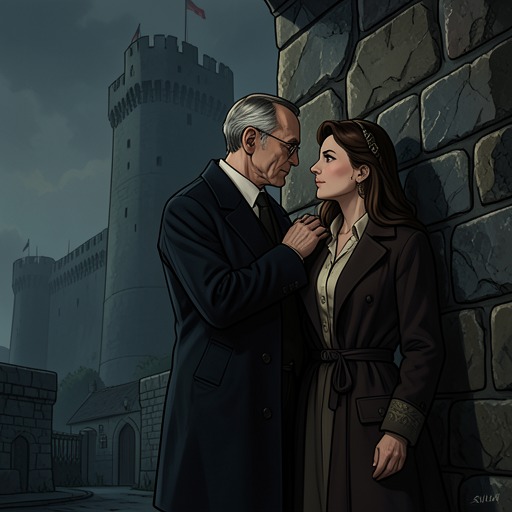
Agnes
Narcissus and GoldmundAgnes, the governor’s mistress, becomes the center of Goldmund’s renewed desire when he encounters her riding through the city. Their clandestine affair joins a vivid awakening of pleasure to the danger of the governor’s household: Agnes arranges a secret meeting, welcomes Goldmund into her bedchamber, and then urges him to escape when the count approaches. Her alarm and his decision not to betray her make the relationship both an intimate encounter and the threshold of Goldmund’s arrest.
Identity and Introduction
Agnes first appears on horseback, distinguished by her tall, light-blond figure, cool blue eyes, and a self-possessed manner. She rides with the authority of someone accustomed to giving orders, yet the narrator’s description also emphasizes her appetite for sensation and pleasure. To Goldmund, she seems at once powerful and vulnerable to passion, a woman capable of meeting him as an equal rather than merely receiving his admiration.
He learns that she lives in the castle as the governor’s mistress. Her beauty immediately gives his wandering attention a new focus. Goldmund thinks her the most beautiful woman he has ever seen, and the encounter awakens a desire not simply to possess her but to test himself against her. He visits a barber to have his hair and beard trimmed, preparing his appearance as he begins to pursue her.
Courtship and Secret Arrangement
For two days Goldmund makes himself visible whenever Agnes leaves the castle. He watches her ride by the ramparts and waits at the gates; when she visits a jeweler, their eyes meet as she comes out. Her nostrils quiver, and on the next morning she answers his persistence with a challenging smile. The silent exchanges turn pursuit into a mutual contest, while Goldmund observes the governor, Count Heinrich, and judges himself superior to the older man, whose beard is gray and whose face carries worry.
Agnes converts this charged courtship into a practical plan. Asking Goldmund’s name, she tells him to bring a chain to the castle toward evening and claim that he found it, keeping it in his possession so that he can deliver it directly to her. He is to enter looking like a beggar, stay calm if a servant scolds him, and seek out either Max, the stable groom, or Berta, her chambermaid. Agnes warns him to be cautious with everyone else in the castle, including the count, and makes clear that the errand may cost him his life.
The danger does not diminish Goldmund’s exhilaration. As he leaves with the chain, bare vineyards and falling yellow leaves surround his walk downhill toward the city. His recent misery seems to have passed as suddenly as a leaf falling from a branch, and he feels life, youth, and joy return. Agnes’s tall figure and blond energy recall the image of his mother that he had carried as a boy at Mariabronn, giving his desire a personal resonance beyond the immediate pursuit.
The Meeting in the Castle
When Agnes finally comes to him, she wears a light blue dress edged with white fur. She explains that the count is dining with a committee of church officials and that their discussion will likely keep them occupied. The time, she says, belongs to the two of them. Her welcome makes the secrecy of the encounter plain: the opening in the household’s watch is temporary, and their intimacy depends on the count’s absence.
Agnes and Goldmund kiss silently before she leads him into her high, candlelit bedchamber. A meal has been set out: bread and butter, a little meat, and white wine poured into a bluish glass. They eat together and drink from the same chalice, their hands exploring one another. The shared food and vessel give the meeting a domestic ease, even as the castle’s danger remains close beyond the room.
Agnes asks where Goldmund has come from and whether he is a warrior, a musician, or simply a poor wayfarer. He answers that he can be whatever she wants and compares her to an instrument he might play. His playful performance of different identities suits the precariousness of his position: he enters the castle as a supposed finder of a chain, while presenting himself to Agnes as wholly hers.
Discovery and Consequences
The intimacy is interrupted by a slammed door and approaching footsteps. Agnes recognizes the count and cries out, directing Goldmund to flee through a closet room and warning him not to betray her. She pushes him into the darkness while the count speaks loudly to her in the adjoining room. Goldmund feels his way among the dresses toward another door, but finds it locked from the outside.
The locked door transforms the closet into a trap. Goldmund understands that someone may have seen him enter and that discovery could cost him his life. Agnes’s plea determines his response: although his heart pounds and fear takes hold, he resolves not to betray her. When the count enters carrying a candlestick and an unsheathed sword, Goldmund hastily gathers dresses and coats over his arm, hoping to be mistaken for a thief. Agnes’s attempt to protect their secret thus ends with Goldmund cornered inside the castle, setting the affair directly against the danger of capture.